Open decision model v1.0.0 / verified 2026-08-25
Build vs Buy AI Agent Scorecard
Build when differentiated behavior, controlled data and deep integration justify durable internal ownership. Buy when the capability is standard and speed matters more than control. Use hybrid when commodity infrastructure can be bought while proprietary policy, adapters and evaluation remain yours.
This page turns that answer into a 12-factor record. Unknown answers reduce evidence coverage, a mandatory constraint can overrule the numeric result and the cost model keeps one-time, annual and exit assumptions separate.
The score is a decision trace, not a verdict machine
A useful sourcing decision shows why each answer was chosen, which facts remain unknown and what would change the outcome. This model was prepared by the Pharos Production AI engineering team as a transparent decision aid, not a product recommendation or a shortcut around discovery.
The number has one job: make competing assumptions visible. It is decision support, not a probability, forecast, confidence score, success rate or financial recommendation. If the evidence gate fails, the tool returns INSUFFICIENT_DECISION_EVIDENCE instead of converting missing facts into false neutrality.
Interactive decision record
Score 12 AI agent sourcing criteria
Choose the statement that current evidence supports. Use Unknown when the evidence is missing. The model will tell you which unanswered constraint blocks readiness.
Decision record
Complete the scorecard to produce a result
The initial state is intentionally unresolved. Choose a preset or answer each criterion, then calculate.
- Evidence status
- Outcome
- Decision index
- Known-weight coverage
No decision has been calculated.
Open formula
How the 31-point signed model works
Each answer is -1 for buy, 0 for hybrid, +1 for build or null for unknown. Multiply that value by the criterion weight, sum known points and normalize only across known weight:
decision index = round(100 x signed known points / known weight)
Buy is -30 or lower. Build is +30 or higher. The interval between them is hybrid. Results within seven index points of either threshold carry a boundary warning because a small evidence change can move the decision.
Readiness is separate from direction
- Known-weight coverage must reach 75%.
- Data control, team capability, lifecycle ownership and compliance path must be known.
- A constraint that blocks the numeric outcome triggers review.
- Unknown never becomes a hidden zero.
The thresholds are versioned editorial defaults. They have not been statistically calibrated against project outcomes.
Compressed comparison
Build, buy and hybrid AI agent paths
The table states the ownership consequence of each path. It does not assume that one path is mature, secure or economical without evidence.
| Decision dimension | Build | Buy | Hybrid |
|---|---|---|---|
| Differentiated logic | Owned end to end | Constrained by product configuration | Owned domain layer over managed components |
| Time to first evidence | Depends on staffing and integration | Can be faster when a credible product fits | Managed baseline followed by owned extensions |
| Data boundary | Designed and operated internally | Defined by vendor architecture and contract | Sensitive zone isolated from replaceable services |
| Integration control | Custom depth and recovery semantics | Supported connector surface | Buy the long tail; own crown-jewel adapters |
| Evaluation | Full custom harness and traces | Vendor evidence plus customer validation | Organization-owned tests around a managed runtime |
| Lifecycle load | Highest internal platform responsibility | Vendor operates more of the platform | Explicitly divided by component and outcome |
| Vendor dependency | Still exists at model, cloud or framework layers | Highest at runtime and commercial layers | Bounded by portable data, logic, evals and adapters |
| Economic pattern | Front-loaded work plus internal recurring cost | Lower setup can become recurring usage exposure | Mixed setup and recurring cost with boundary overhead |
Decision surface
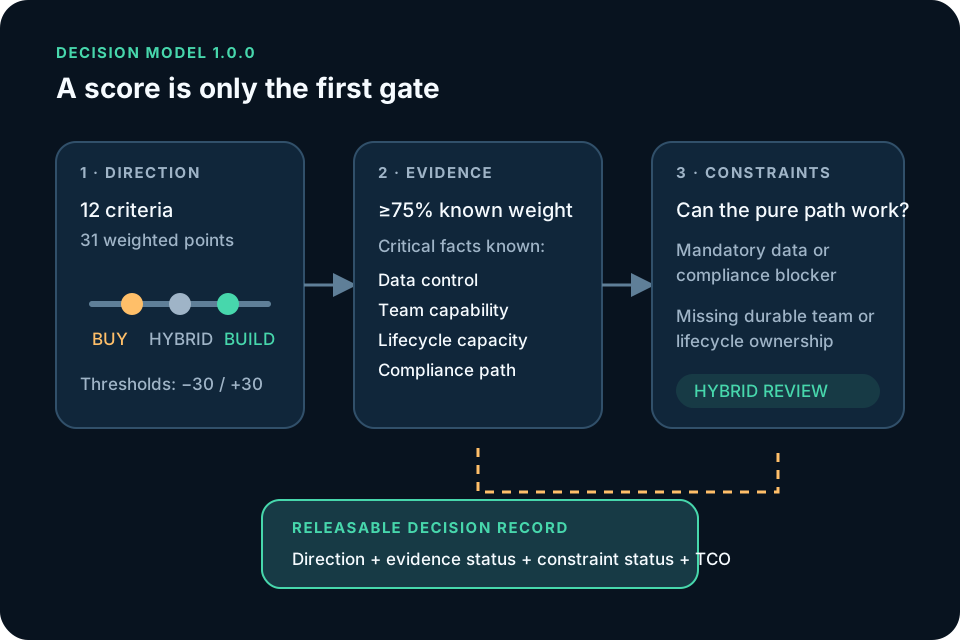
Direction, evidence and constraints are three different axes
A build-leaning index is not ready when critical evidence is absent. A buy-leaning index is not actionable when a mandatory data or compliance constraint blocks the vendor path. The decision record therefore evaluates direction first, readiness second and blocking constraints third.
- Compute direction from known weighted answers.
- Withhold the decision if evidence coverage fails.
- Override a conflicting shortcut with constraint review.
- Pair the surviving path with TCO and an exit test.
Architecture boundary
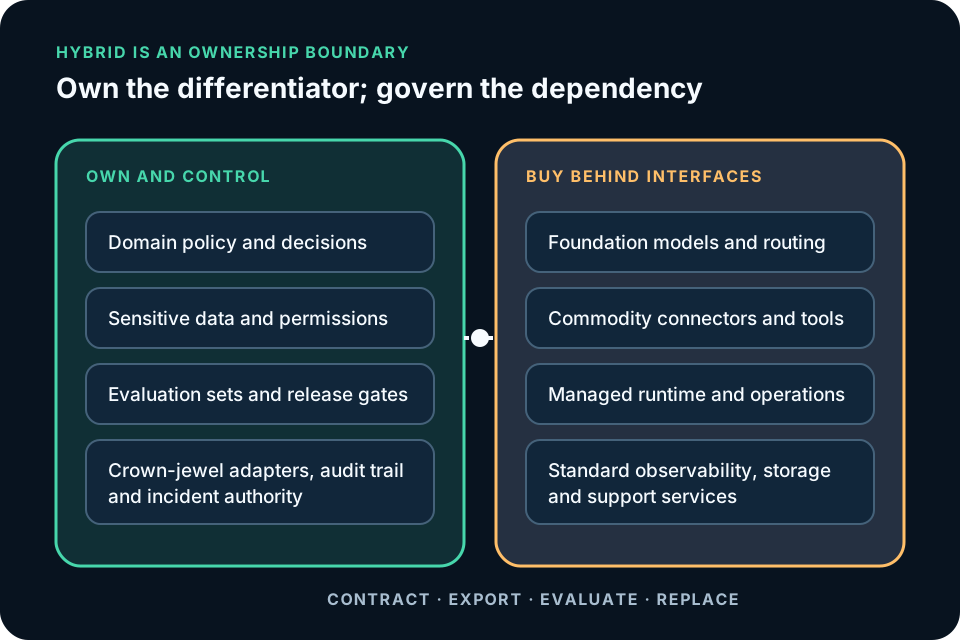
Hybrid means owning the parts that preserve differentiation and control
The criteria extend the build vs buy AI agent decision framework with explicit unknown handling, boundary warnings and exportable evidence. The most useful hybrid design assigns ownership by component instead of splitting the project by percentage.
- Usually own
- Domain policy, approval rules, sensitive data boundaries, evaluation sets, release gates and crown-jewel adapters.
- Often buy
- Foundation model access, standard connectors, baseline administration, commodity observability and replaceable infrastructure.
- Contract explicitly
- Data use, exports, logs, termination help, deletion, service levels, change notices and support boundaries.
- Test before approval
- Identity fidelity, action authorization, failure recovery, trace export and redeployment after simulated vendor exit.
Editable cost model
Compare three-year total cost of ownership
The worked scenario is illustrative. It is not Pharos pricing, a vendor quote or a market benchmark. Replace every amount with your own approved labor, platform, usage, control and exit assumptions.
Illustrative three-year result
Calculate to refresh the totals after editing any amount.
Build
- One-time
- Annual
- Exit
Buy
- One-time
- Annual
- Exit
Hybrid
- One-time
- Annual
- Exit
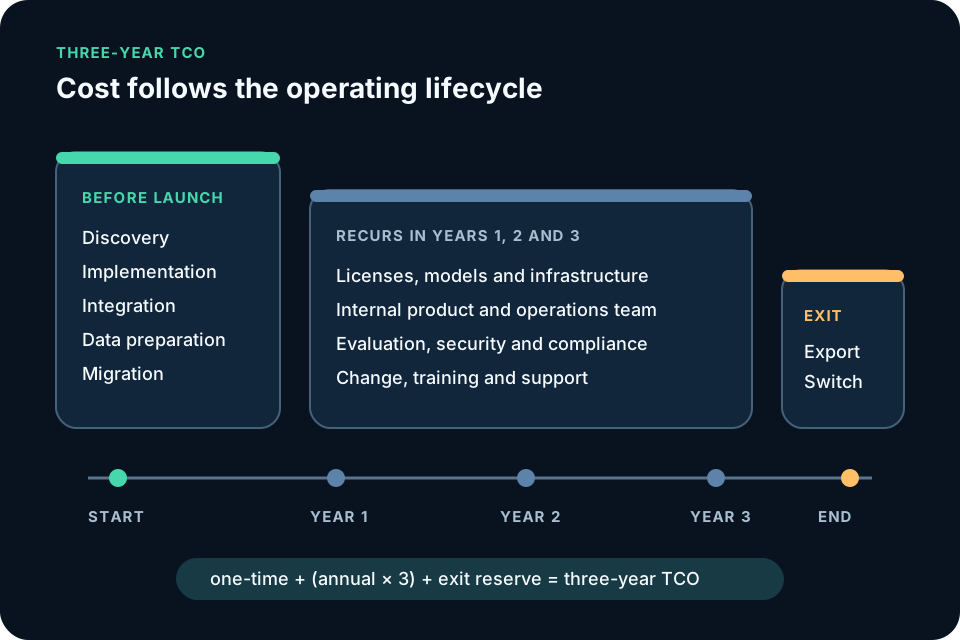
Formula: one-time total + (annual total x 3) + exit reserve. Lowest modeled cost does not override mandatory constraints or prove the best outcome.
Cost cadence
Three-year TCO must keep recurring ownership visible
A setup quote and an annual subscription answer different questions. The model groups discovery, implementation and migration as one-time costs; it multiplies infrastructure, internal operations, evaluation and support by three; then it adds an explicit exit reserve.
For a meaningful comparison, attach a measurable unit such as cost per successful task, per resolved case, per active user or per approved action. That lets the team distinguish growth from waste and compare architecture changes with business value.
Decision scenarios
When build, buy and hybrid become defensible
These scenarios illustrate evidence patterns. They are not client cases, outcome claims or substitutes for your own data.
Buy: a common internal workflow
Buy becomes defensible when credible products cover the workflow, data handling is approved, connector depth is standard and a measurable baseline is needed before a custom team could be staffed.
Proof to collect
- Production-like connector test
- Data-flow and deletion evidence
- Usage and renewal cost bands
- Exit export and redeployment test
Build: a controlled differentiated system
Build becomes defensible when proprietary policy or feedback creates durable advantage, the vendor shortlist fails a binding constraint and a named team can own evaluation, operations and incidents.
Proof to collect
- Architecture and trust boundary
- Named owner capacity
- Domain evaluation set
- Three-year staffing and operations budget
Hybrid: own the control spine
Hybrid becomes defensible when models, connectors or administration are replaceable but domain policy, sensitive data, evals and crown-jewel integrations must remain portable and organization-owned.
Proof to collect
- Component ownership map
- Shared-control RACI
- Portable prompt, state and eval assets
- Migration gate after a live baseline
Vendor diligence
Test what the vendor path actually owns
- Data: trace input, state, logs, training use, retention, deletion and subprocessors.
- Identity: verify SSO, role mapping, delegated authorization and service-account boundaries.
- Actions: test approval, idempotency, rollback, reconciliation and immutable audit evidence.
- Quality: run your domain set and export traces, failures, costs and version identifiers.
- Commercials: model seats, usage, support, overages, renewal, price changes and termination help.
- Exit: export workflows, prompts, data, evals, logs and configuration, then redeploy a critical slice.
Build diligence
Prove the internal path can be operated
- Product: name the outcome, owner, affected users, wrong-action cost and stop condition.
- Platform: assign runtime, data, identity, observability, deployment and on-call ownership.
- Evaluation: version test data, failure labels, release gates and human-review thresholds.
- Security: map tool permissions, secret handling, egress, memory and supply-chain controls.
- Maintenance: budget model changes, API churn, drift, data repair, user support and incidents.
- Opportunity cost: identify the roadmap work displaced by platform ownership.
Failure modes
Six ways teams manufacture a confident answer
Importance becomes differentiation
A workflow can be important without being proprietary. Ask what a competitor cannot reproduce by purchasing the same platform.
Unknown becomes neutral
Missing data is assigned a middle score and quietly increases certainty. This tool removes unknown weight and can block readiness.
Demo fit becomes production fit
A polished prompt hides permissions, failure recovery, auditability, support and real data. Test the hardest production slice.
Code ownership becomes portability
Owning source code is incomplete if state, prompts, evals, logs or deployment remain trapped in a vendor runtime.
Setup cost becomes TCO
Labor, evaluation, security, operations, support, downtime and exit work disappear from the comparison. Keep cadence visible.
Platform operation has no owner
A build proposal names developers but not product, data, security, release, incident and on-call owners. Treat that as a blocked build.
Method, evidence and E-E-A-T
What is sourced, what is authored and what remains unverified
The model separates external evidence from editorial decisions. Current sources support the relevance of lifecycle risk, TCO breadth, readiness and recurring make-or-buy factors. No cited source validates the 31-point weights, -30/+30 thresholds, seven-point boundary or illustrative dollar amounts.
- Publisher
- Pharos Production Editorial Team
- Model version
- 1.0.0
- Published and verified
- Independent review
- Independent technical review was not performed for this release.
- Drafting disclosure
- AI-assisted drafting was used; the release was source-checked and mechanically tested.
- Update policy
- Review source status and model assumptions at least quarterly or after a material framework, regulation or vendor-market change.
- Correction policy
- Document material corrections in the public changelog, update the model version when behavior changes and retain source boundaries.
- Scope boundary
- Architecture and procurement decision support only; not legal, security, compliance or financial advice.
Authoritative and research sources
- NIST AI Risk Management Framework Voluntary full-lifecycle guidance; v1.0 is under revision.
- NIST AI 600-1 Generative AI Profile Cross-sectoral risk actions; no sourcing thresholds.
- FinOps Foundation terminology TCO and unit-economics definitions; no AI-agent pricing.
- KPMG build-buy-borrow paper Consultancy-authored readiness framework with a commercial interest.
- Klotz, The Buy-or-Build Decision, Revisited Conceptual preprint, not an empirical calibration study.
Open artifacts
Questions the model leaves open
Build vs buy AI agent FAQ
Why does an unknown answer not count as hybrid?
Hybrid is a sourcing choice supported by evidence. Unknown means the evidence is absent, so the model removes that criterion's weight and can withhold a decision.
Does the lowest three-year TCO automatically win?
No. TCO is one decision record. A cheaper path can still fail a mandatory data, security, compliance, integration or operating constraint.
Can this scorecard select a specific AI agent vendor?
No. It selects a sourcing posture. Specific vendors still require feature validation, data-flow review, contract analysis, security testing and an exit test.
When should the build-versus-buy decision be rerun?
Rerun it after a production-like proof, a material pricing or contract change, a new regulatory constraint, an architecture change or a shift in demand and staffing.
Does buying an AI agent transfer accountability to the vendor?
No. A vendor can operate part of the stack, but the organization still owns use-case approval, data access, outcome monitoring, human oversight and incident decisions.