Evidence cutoff · Method v1.0.0
Top 5 AI Agent Frameworks for Enterprise Workflows
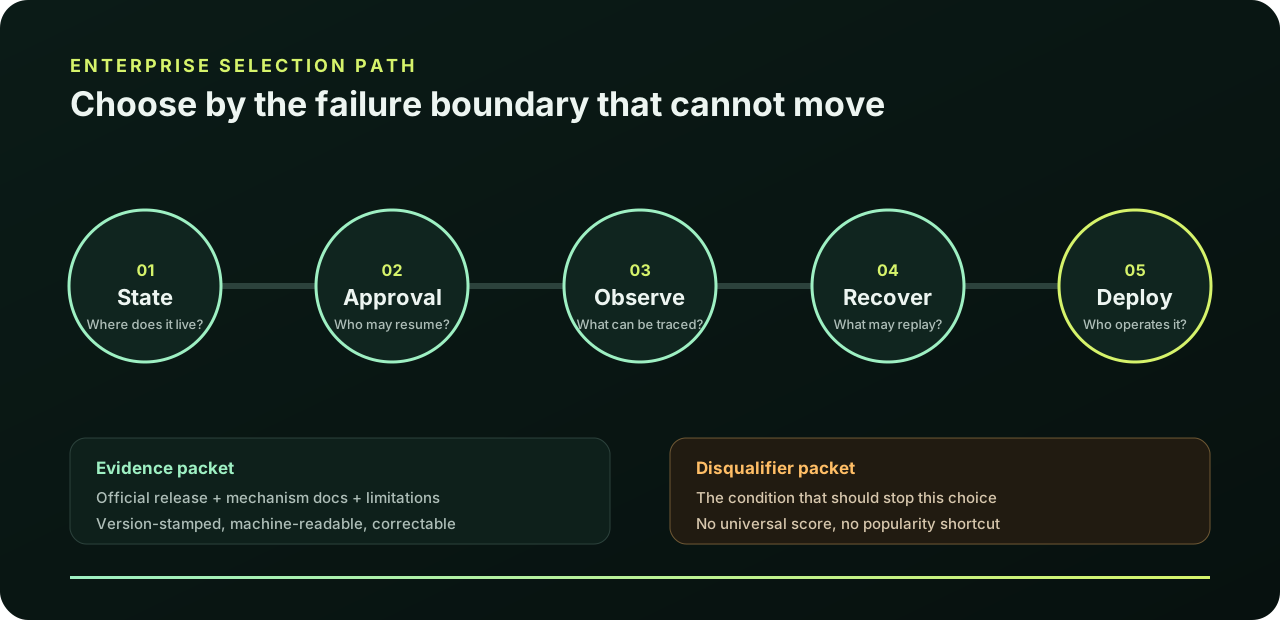
There is no universal winner. LangGraph is the strongest fit for explicit durable state graphs; Microsoft Agent Framework for Microsoft-stack workflow control; CrewAI for role-oriented Python teams; OpenAI Agents SDK for a compact OpenAI-centered runtime; and Google ADK for multi-language Google Cloud programs. The choice changes when state, approval, observability, recovery or deployment becomes the hard constraint.
- Compared
- 5 frameworks
- Control axes
- 5 operating constraints
- Evidence
- Official docs and releases
- Ranking model
- No universal score
Direct answer
What makes an AI agent framework enterprise-ready?
An AI agent framework is a software runtime or library that coordinates model calls, tools, state, handoffs and control flow across a multi-step task. Enterprise readiness begins when the workflow can explain where state lives, who may approve an action, what telemetry exists, how execution resumes after failure and where the runtime is operated.
A custom AI software development team evaluating these frameworks should start with failure semantics, not demo speed. If an invoice approval pauses for two days, a worker restarts and the payment tool times out, the architecture must know which state is durable, which action may replay and which human decision still binds.
Interactive decision artifact
Build a framework shortlist from operating constraints
The selector treats language and deployment control as hard filters. Priority and model strategy change ordering only. The result says which options fit the stated inputs; it does not turn documentation into a quality score.
Current shortlist
Five documented options
All five frameworks remain visible until a hard language or deployment constraint is selected.
Same criteria, every option
Enterprise AI agent framework comparison matrix
Status vocabulary: native means the documented mechanism is part of the framework; integrated means a documented companion product or telemetry path supplies it; configured means the framework exposes the mechanism but production durability depends on added storage or runtime work; external-runtime means recovery is delegated to another workflow engine.
| Framework and release | State | Human approval | Observability | Recovery | Deployment | Primary disqualifier |
|---|---|---|---|---|---|---|
| LangGraph Python 1.2.11 · MIT | Native Thread checkpoints | Native Interrupt and resume | Integrated LangSmith path | Native Durable execution | Application runtime or Agent Server | Too much machinery for a short deterministic sequence |
| Microsoft Agent Framework Python 1.16.0 · MIT | Native Superstep checkpoints | Native RequestPort and tool approval | Native Traces, metrics and logs | Native Restore and rehydrate | In-process, application service or Azure path | Exact behavior differs across language and UI integrations |
| CrewAI Python 1.15.18 · MIT | Native Persisted Flow state | Native Human feedback routing | Integrated Traces and AMP | Configured Resume by Flow ID | Self-hosted Python or AMP | No Python boundary, or graph checkpoints are the core model |
| OpenAI Agents SDK Python 0.22.0 · MIT | Native Pluggable sessions | Native Serialized interruptions | Native Built-in tracing | External runtime Dapr, Temporal, Restate or DBOS | Application-owned Python runtime | Provider neutrality or built-in workflow server is mandatory |
| Google ADK Python 2.8.0 · Apache-2.0 | Native SessionService state | Native Graph human input | Integrated OpenTelemetry and Cloud Trace | Native Resumable workflow sessions | Agent Runtime, Cloud Run, GKE or self-host | Cloud-neutral operations or exact cross-language parity |
The matrix deliberately excludes GitHub stars, anecdotal adoption and vendor marketing maturity labels. Those signals do not answer whether a paused side effect can resume safely.
Five distinct operating fits
Where each framework fits, and where it fails
01 · Explicit control
LangGraph: durable state graphs with visible replay boundaries
Version 1.2.11, Python core, released , MIT license.
LangGraph turns the workflow into a state graph. Nodes perform work, edges express routing and a checkpointer records snapshots under a thread. That model earns its place when a run can pause, branch, loop or recover and the team must inspect exactly which state will be restored.
- State and recovery
- Checkpointed graph state supports time-aware resume. Smaller nodes create more frequent recovery boundaries but may increase orchestration overhead.
- Human approval
interrupt()pauses the graph andCommand(resume=...)continues the same thread after an external decision.- Observability
- LangSmith is the documented integrated tracing and evaluation path. It is separable from the open-source runtime and can be disabled where trace data is sensitive.
- Deployment
- Run the library in application infrastructure, or use Agent Server for a graph API, persistence and durable task queue.
Choose it when: process state and replay boundaries are architecture, not implementation detail. Do not choose it when: ordinary code, a queue and a database can express the complete deterministic workflow more clearly.
02 · Microsoft-stack workflow control
Microsoft Agent Framework: checkpoints, requests and typed enterprise integration
Python 1.16.0, released , MIT license; .NET and Go tracks are versioned separately.
Microsoft Agent Framework is the current Microsoft path that combines agent abstractions with explicit workflows. Its checkpoint manager captures executor state, pending messages, requests and shared state at superstep boundaries. RequestPort and tool-approval requests make external input part of the workflow rather than an improvised chat turn.
- State and recovery
- Checkpoints can resume or rehydrate execution, and pending approval requests are re-emitted after restore.
- Human approval
- Custom requests and tool approvals pause workflow progress until the application supplies a response.
- Observability
- The documented agent surface exports traces, metrics and logs; hooks provide a common interception seam for policy and instrumentation.
- Deployment
- Workflows run in process or behind enterprise services, with the strongest documented operating path in the Microsoft and Azure ecosystem.
Choose it when: .NET or Azure integration, typed middleware and Microsoft operational tooling are already constraints. Do not choose it when: your acceptance criteria assume identical workflow lifecycle support across Python, .NET, Go and every UI adapter.
03 · Role-oriented multi-agent work
CrewAI: concise crews backed by persistent, routable Flows
Version 1.15.18, released , MIT license.
CrewAI separates role-based agent collaboration from Flow orchestration. Crews describe agents, tasks and delegation. Flows add event routing, explicit state, persistence and human-feedback points. That split is useful when business roles are the natural authoring surface, but production control still needs a workflow boundary.
- State and recovery
@persiststores Flow state, uses SQLite by default and supports resume or fork by state ID. Production storage and side-effect replay remain application decisions.- Human approval
@human_feedbackpauses a Flow and can route approval, rejection or revision outcomes to different listeners.- Observability
- Execution traces are available in the framework; AMP adds managed monitoring, logs, access controls and deployment operations.
- Deployment
- Self-host a Python service or use AMP through GitHub, CLI or Studio deployment paths.
Choose it when: a Python team needs quick multi-agent composition and can use Flows for operational control. Do not choose it when: the application has no Python service boundary or the primary design language must be a low-level checkpointed state graph.
04 · Compact provider-first runtime
OpenAI Agents SDK: sessions, approvals and tracing with external durability
Python 0.22.0, released , MIT license.
OpenAI Agents SDK deliberately keeps the core small: agents, a runner, tools, handoffs, guardrails, sessions and traces. That reduces framework surface for an OpenAI-centered product. It also makes the durability boundary explicit: a serializable RunState can pause for approval, while automatic recovery across process restarts uses Dapr, Temporal, Restate, DBOS or application infrastructure.
- State
- Sessions support application-owned stores such as SQLite, Redis, SQLAlchemy, Dapr and encrypted or file-backed variants, plus OpenAI-managed conversation state.
- Human approval
- Tools declare approval requirements, interruptions surface to the outer run and unresolved decisions remain pending in serialized RunState.
- Observability
- Built-in tracing records generations, tool calls, handoffs, guardrails and custom events, with controls for sensitive inputs and outputs.
- Recovery and deployment
- The SDK lives inside your Python service. Long waits, restart recovery and durable worker execution require a documented external workflow integration.
Choose it when: OpenAI models and tools are the default, the team wants a compact SDK and external durability is acceptable. Do not choose it when: procurement requires provider neutrality or a built-in graph server must own checkpoints and worker recovery.
05 · Multi-language Google Cloud path
Google ADK: sessions and workflow agents across five language ecosystems
Python 2.8.0, released , Apache-2.0 license; other SDK tracks are versioned separately.
Google ADK spans Python, TypeScript, Go, Java and Kotlin, with LLM agents plus deterministic sequential, parallel and loop agents. Persistent SessionService implementations carry state beyond a process, graph workflows can request human input and the Google operating path covers Agent Runtime, Cloud Run and GKE.
- State
- Session state must be serializable. DatabaseSessionService and VertexAiSessionService persist it; InMemorySessionService explicitly loses it on restart.
- Human approval and recovery
- Graph human-input and resume mechanisms preserve workflow position when the backing session implementation is durable.
- Observability
- OpenTelemetry instrumentation connects model and tool traces to Cloud Trace; analytics can extend into BigQuery with separate content-capture implications.
- Deployment
- Documented targets include Agent Runtime, Cloud Run and GKE, with identity, secrets, scaling and CI/CD choices exposed through Google tooling.
Choose it when: a multi-language program is already committed to Gemini or Google Cloud operations. Do not choose it when: cloud neutrality is a hard boundary or the project assumes every SDK language exposes the same feature at the same time.
The failure mode most comparisons skip
Checkpoint recovery is not side-effect recovery
A checkpoint answers, "What did the workflow know and where was it executing?" It does not answer, "Did the external system already commit the action?" If a tool writes to a ledger, sends a message or opens a support ticket and the worker fails before the checkpoint records completion, a resumed node may repeat the effect.
- Assign an idempotency key before the side effect. Persist it with workflow state so a retry uses the same key.
- Separate request from confirmation. Record the external request identifier, then reconcile status instead of blindly calling the tool again.
- Define replay boundaries per node or executor. A large node repeats more work; a tiny node creates more state and coordination overhead.
- Version the checkpoint schema. A code deploy can make old state unreadable even when the storage backend is healthy.
- Test kill-and-resume behavior. Stop a worker before, during and after the side effect, then verify state, approvals and external records.
This is why recovery status in the matrix is not a generic "yes". The useful question is which execution position survives, where that state is stored and what the application must do to prevent duplicate effects.
Procurement and architecture gate
Seven questions to answer before a proof of concept
- State: Which values are durable, which are session-only and which are reconstructed?
- Approval: Can the run wait across a process restart, and how is the approver authenticated?
- Recovery: Where is execution checkpointed, and which tool calls can replay?
- Observability: Are prompts, tool arguments, state transitions, costs and approval decisions traceable without leaking restricted data?
- Deployment: Who operates workers, queues, state stores, secrets, network policy and scaling?
- Portability: Which framework types cross the business logic boundary, and what would migration replace?
- Testing: Can model calls, tools, interrupts and failure points be exercised deterministically in CI?
Valid sixth answer
When an enterprise workflow should use no agent framework
Do not add an agent framework merely because a model calls a tool. A bounded workflow with deterministic branches, one or two model calls and a small tool surface is often clearer as ordinary application code backed by a database, job queue and OpenTelemetry. The no-framework option reduces dependency churn and keeps failure semantics in familiar infrastructure.
A framework becomes easier to justify when at least one condition is structural: the run spans long waits, state branches and loops, humans intervene mid-run, multiple agents coordinate, a durable resume position matters or the team needs a standardized trace of model and tool transitions. If none applies, the framework may be an abstraction tax.
Reproducible method
How the top five were selected and verified
The label "top" means admitted to this bounded enterprise shortlist, not ranked from first to fifth. Each candidate had to be maintained at the cutoff, code-first, permissively licensed and documented across the five operating axes. We did not use GitHub stars, a subjective maturity score, vendor revenue or unverified customer claims.
- Set the decision boundary. Compare frameworks developers embed in an enterprise agent service, not no-code automation products, standalone models or off-the-shelf agents.
- Verify the release. Record the official repository tag, publication date and license for one declared language track.
- Map mechanisms. Attach official documentation to state, approval, observability, recovery and deployment statements.
- Write the boundary beside the capability. A persistent session, managed trace or approval callback is described with what it does not supply.
- Apply one matrix. Every framework receives a best-fit scenario, operating constraint, trade-off, evidence set and disqualifier.
- Keep uncertainty visible. Cross-language parity, managed-service entitlement and application-owned controls are not inferred from a product overview.
Non-duplicative questions
Enterprise agent framework FAQ
What is the best AI agent framework for enterprise workflows?
There is no universal winner. LangGraph fits explicit durable graphs, Microsoft Agent Framework fits Microsoft-stack workflows, CrewAI fits role-oriented Python teams, OpenAI Agents SDK fits compact OpenAI-centered applications and Google ADK fits multi-language Google Cloud programs. Choose by the first operating constraint your architecture cannot move.
Which framework has built-in human approval?
All five expose a documented human-input or tool-approval mechanism. None turns that primitive into a complete enterprise control. The application still needs approver identity, authorization, timeout, escalation, audit retention and separation of duties.
Does session memory provide failure recovery?
No. Conversation memory preserves context. Failure recovery also requires execution position, durable checkpoints, retry and replay rules and idempotent external side effects. A session that remembers a conversation may still repeat a payment or email after restart.
Should a simple AI workflow use an agent framework?
Often no. A short deterministic sequence with a few tool calls is usually easier to test and operate in ordinary application code. Add a framework when stateful branching, long waits, approvals, multi-agent coordination or resumable execution justify it.
Why is AutoGen not a separate entry?
Microsoft identifies Agent Framework as the direct successor that combines AutoGen's agent abstractions with Semantic Kernel's enterprise features and adds graph workflows. Keeping both would duplicate one ecosystem path inside a five-item current shortlist.
Who, how and why
Editorial ownership, review status and corrections
- Publisher and evaluator
- Pharos Production Engineering Editorial. Pharos is not a ranked framework and no vendor paid for inclusion.
- Research cutoff
- . Release versions and docs were verified against official sources on that date.
- Production process
- AI-assisted drafting was used for synthesis and copy preparation. Deterministic tests check the set, fields, links, data parity and selector behavior.
- Review status
- Official-source factual review and deterministic QA were completed. Independent technical review was not performed for this release.
- Correction policy
- Report a version or capability error to hello@pharosproduction.com with the framework, source URL and affected matrix field. Verified corrections are added to the dated changelog.
- Decision boundary
- This is engineering decision support, not a vendor endorsement, procurement guarantee, security assessment or compliance certification.